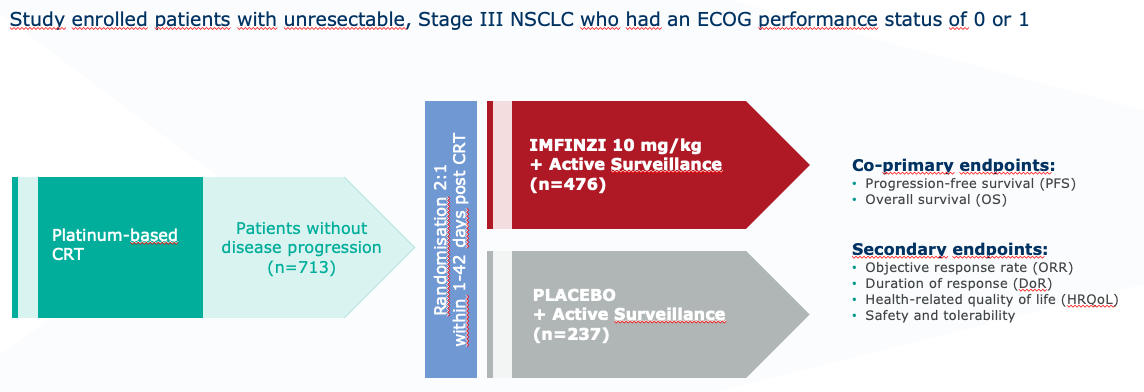
PACIFIC study design2
PACIFIC Updated OS (PD-L1 ≥1% population)*
Imfinzi – Overall survival 50.1% after 5 years3
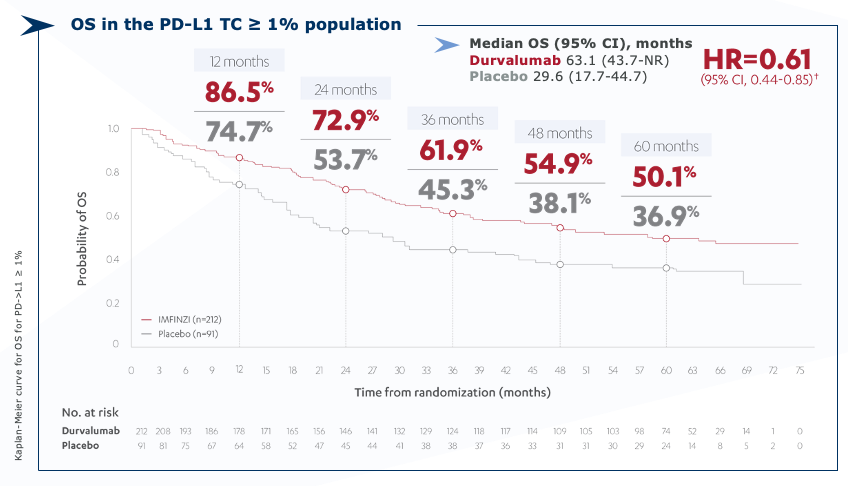
* Prespecified and exploratory post-hoc subgroup analysis. Unstratified HR, no statistical analyses performed for this comparison.
CI=confidence interval; HR=hazard ratio; NR=not reached; OS=overall survival; PD-L1=programmed cell death-ligand 1; TC=tumor cell.
† Treatment effect estimated using an unstratified Cox proportional hazards model.
PACIFIC updated PFS (PD-L1 ≥ 1% population by BICR)*
Imfinzi – 35.8% of patients had not progressed after 5 years3
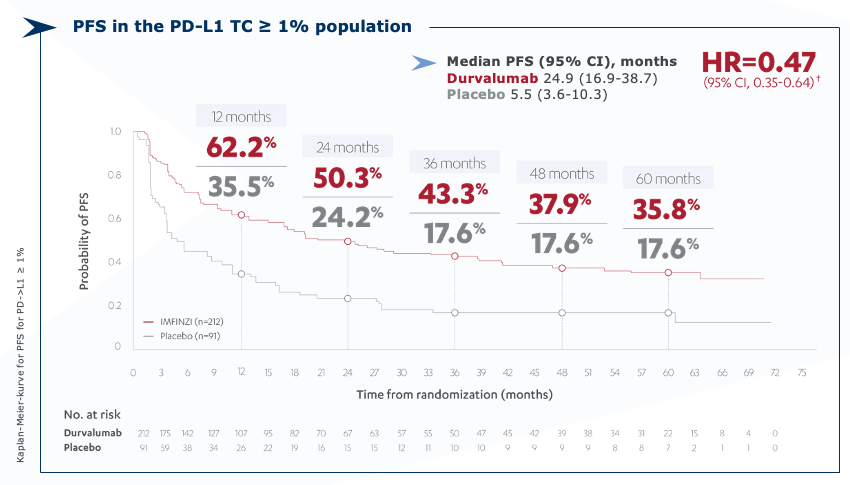
* Prespecified and exploratory post-hoc subgroup analysis. Unstratified HR, no statistical analyses performed for this comparison.
BICR= Blinded Independent Central Review confidence interval; HR=hazard ratio; NR=not reached; PD-L1=programmed cell death-ligand 1; PFS=progression-free survival; TC=tumor cell.
† Treatment effect estimated using an unstratified Cox proportional hazards model.
PACIFIC updated PFS (ITT-population)
Imfinzi -33,1% had not progressed after 5 years.3*
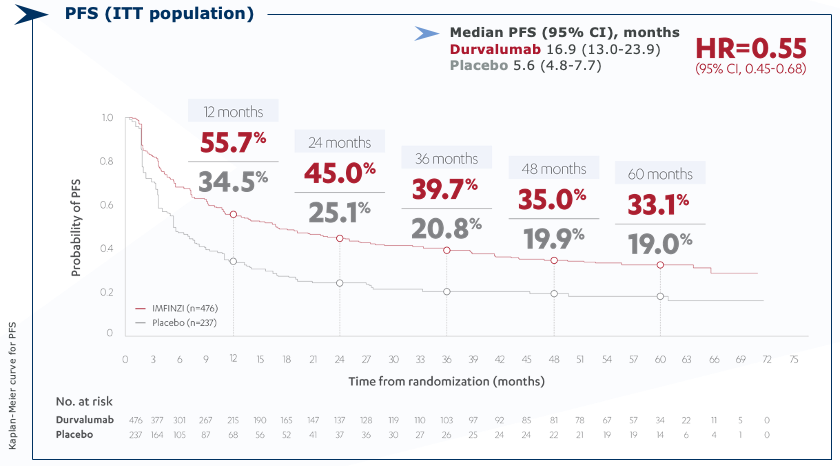
* Stratified HR. Statistical analysis not performed for this comparison. Stratified HR from the primary analysis of median PFS, (95% CI): 0.52 (0.42 to 0.65), p<0.0001.
CI=confidence interval; HR=hazard ratio; ITT=intention-to-treat; NR=not reached; PFS=progression-free survival.
PACIFIC study
Progression-free survival (PFS) across prespecified subgroups (ITT population)3
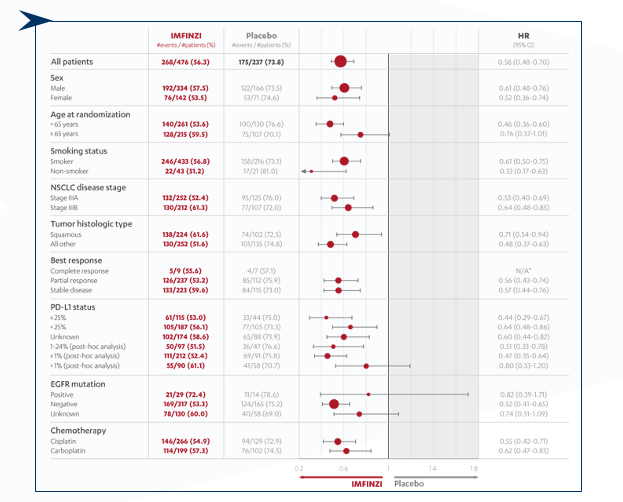
CI=confidence interval; HR=hazard ratio; ITT=intention-to-treat; PFS=progression-free survival.
Safety
In the PACIFIC study
IMFINZI vs. placebo following CRT1
Any-grade immune-mediated adverse events reported in ≥1% of patients2
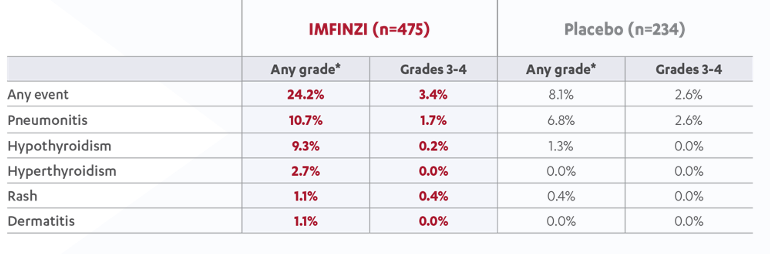
* Grade 5 immune-mediated AEs occured in 4 patients (0.8%) recvieving durvalumab and 3 patients (1.3%) recieving placebo.
Overall the safety profile of durvalumab in PD‑L1 TC ≥ 1% subgroup was consistent with the intent to treat population, as was the PD‑L1 TC < 1% subgroup.